What does AiVIS return in one audit?
Each audit returns a real validated 0 to 100 visibility score, category grades, evidence linked findings, and prioritized recommendations based on observed page structure and content.
AiVIS shows how ChatGPT, Perplexity, Claude, and Google AI likely interpret your website. It returns a visibility score with evidence-linked findings instead of generic SEO tips. Teams can prioritize the biggest citation blockers first, ship fixes quickly, and re-audit to verify movement. The platform is designed for operators, agencies, and developers who need repeatable score improvement workflows.
AiVIS is an AI visibility audit platform that shows whether answer engines can parse, trust, and cite your page clearly. Each report ties findings back to real page evidence and turns them into practical fixes.
The platform is built for teams that need measurable improvements, not generic advice. Every audit evaluates content depth, heading hierarchy, schema quality, metadata quality, technical SEO signals, and AI readability. The output is designed for operators, marketers, and developers who need to ship changes and verify score movement with repeatable evidence.
Teams use AiVIS as an execution system instead of a one-time scanner. Each run identifies the exact evidence behind weak categories, then maps those findings into implementation-ready tasks. This keeps optimization cycles focused on high-confidence fixes such as answer-block expansion, schema alignment, metadata precision, and trust-page linking patterns that retrieval models can verify quickly.
AiVIS emphasizes machine readability first: what an answer engine can extract quickly, verify, and reuse in generated responses. That means concise factual blocks, clear entity framing, complete JSON-LD relationships, strong internal linking to trust documents, and updated page-level context that reduces ambiguity during retrieval and generation.

AiVIS audits the structural and content signals that affect whether AI systems can confidently interpret and reuse your content.
The scoring model is not a black box. Category grades are mapped to observed page facts and evidence excerpts, so teams can see exactly why a score is high or low. This approach makes remediation predictable and helps stakeholders understand what changed between scans.
Strong outcomes usually come from balanced improvements across all six categories. Pages with only technical fixes but thin content often remain hard for AI systems to cite, while pages with long content but weak schema often lose extractability. AiVIS helps teams avoid these one-sided updates by showing category-level tradeoffs in one place.
AiVIS also emphasizes interpretation clarity by checking whether claims are explicit, numerically grounded, and easy for retrieval systems to verify without guessing. Pages that define terms, scope, and outcomes with direct language generally perform better in answer generation than pages that rely on promotional phrasing alone. In practice, teams gain the biggest lift when they combine richer topical depth with unambiguous statement structure, complete metadata coverage, and machine-readable proof signals that reduce model uncertainty.
AiVIS also includes workflow surfaces for competitor comparison, citation testing, keyword prioritization, historical reports, and reverse-engineering answer behavior.
These workflows are intended to turn audits into operational loops. Teams can identify competitor gaps, map priority topics, run fresh audits after implementation, and compare trend movement over time. The goal is consistent visibility gains, not one-time score spikes.
Founder note: I built AiVIS.biz after realizing most websites are invisible to AI
Related read: I used to build websites so people could see them — now they must be machine-legible too
Also on Medium: Why I built AiVIS when I realized most websites are invisible to AI
AiVIS uses evidence-grounded analysis to score what AI systems can actually extract from a page. Eligible paid tiers can include deeper multi-model validation for stronger review.
For each recommendation, AiVIS attempts to maintain a BRAG trail: build findings from observed fields, reference explicit evidence, audit recommendation linkage, and ground claims in stored outputs. This allows teams to prioritize recommendations that are verified by crawl evidence before tackling advisory suggestions from critique models.
High-confidence improvements usually come from expanding topical depth, clarifying entity context, increasing schema specificity, and adding direct answer blocks that are easy for retrieval models to quote. The methodology page documents these rules so teams can standardize implementation quality.

Answer engines perform better when pages include concise, explicit, and verifiable statements. AiVIS recommendations emphasize direct Q/A sections, clear entity naming, and complete context for product claims so models can safely quote your content without inference gaps.
Each audit returns a real validated 0 to 100 visibility score, category grades, evidence linked findings, and prioritized recommendations based on observed page structure and content.
Clear entities, complete schema, one strong H1, reliable metadata, enough topical depth, and concise answer style sections all improve LLM readability.
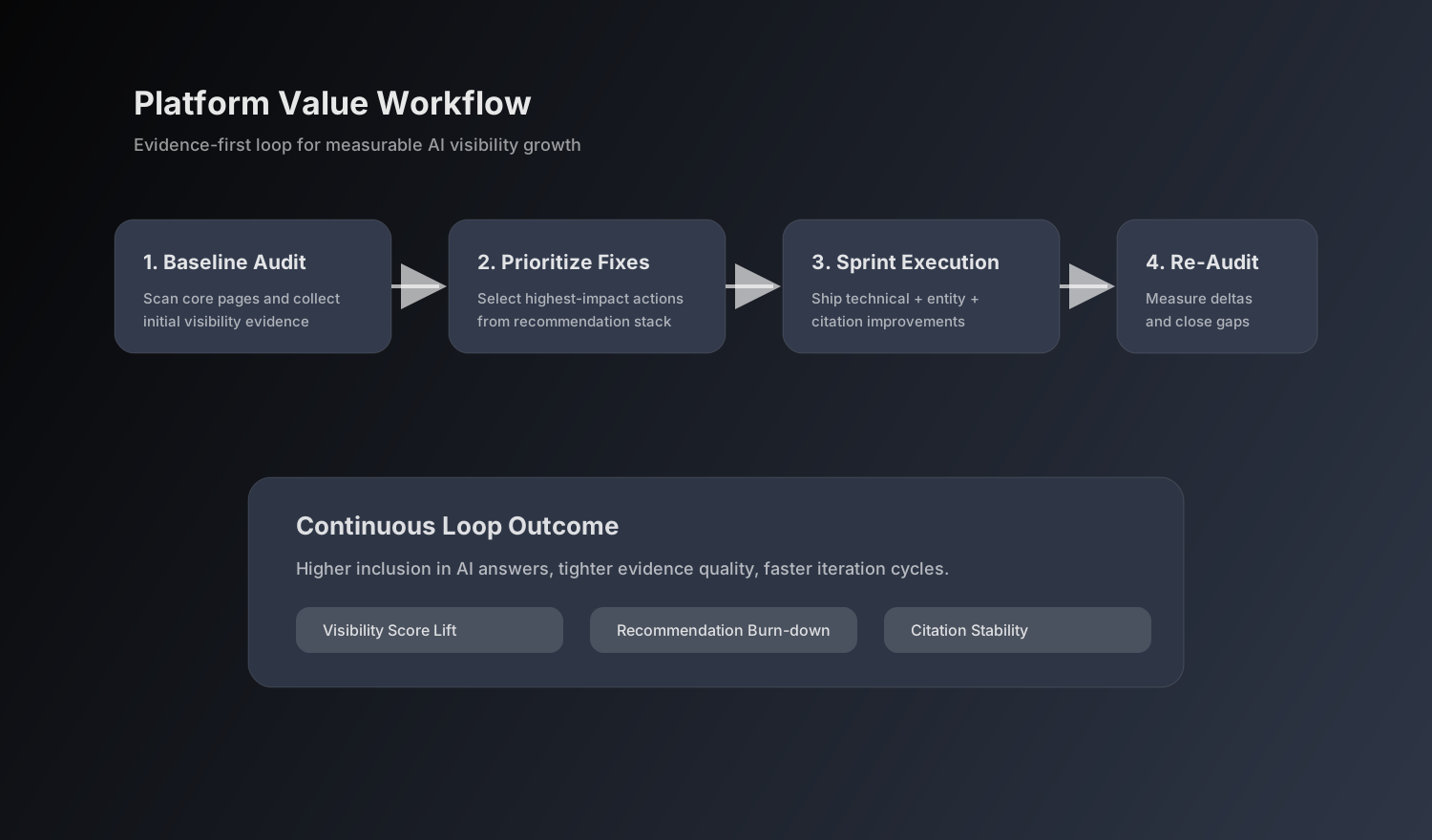
Run a baseline audit, fix one cluster of issues, re-audit, and compare score and category deltas instead of guessing whether changes worked.
Low depth scores usually indicate sparse explanations, weak examples, or short sections that do not provide enough context for answer engines. Expanding each core section with concrete, factual, implementation-level details often improves both readability and citation potential.
Alert channels like Slack and Discord are best for immediate visibility when a new audit completes. Automation bridges like Zapier are best for orchestration across systems such as Notion, Airtable, and CRM pipelines. This separation helps teams avoid alert fatigue while still routing structured audit outputs into execution queues.
Metadata should be concise and specific. A strong meta description usually lands between 120 and 155 characters, includes the primary value proposition, and naturally incorporates key terms for AI visibility, structured scoring, and implementation-ready fixes.
Quantity of schema blocks is not enough. Schema value comes from quality, valid relationships, accurate entity references, and page-appropriate types. AiVIS audits whether structured data is complete and coherent enough for machine interpretation, not just present in markup.
Methodology, privacy, terms, help, and compliance pages improve trust signaling by clarifying governance, data handling, and product claims. Internal links to these pages help answer engines verify legitimacy and policy context when evaluating whether to cite a source.
AiVIS evaluates 25+ structural signals across 6 weighted categories to produce each visibility score. Understanding the grade thresholds helps teams set realistic targets and prioritize the categories with the highest composite weight first.
Content Depth and AI Readability each carry 20% of the composite score, making them the two highest-impact categories. Schema and Structured Data also carries 20%. Technical SEO contributes 15%, Meta Tags contribute 13%, and Heading Structure contributes 12%. Teams that focus on all three 20% categories first typically see the fastest composite movement.
Pages scoring 90 or above in Content Depth typically contain 1,600 or more words of substantive, entity-rich content with concrete statistics and verifiable claims. Pages below 800 words rarely exceed a B grade regardless of structural quality. Adding 3 to 5 concise answer blocks each containing specific numbers, named entities, and direct factual statements is the most reliable path from B to A in content scoring.
A-grade heading structure requires a single H1 element, 6 or more H2 sections, and 6 or more H3 subsections providing topical depth within each H2 group. Pages with H1 plus 8 to 12 H2s and 8 to 15 H3s consistently score between 90 and 100. Missing or duplicate H1 tags cap the heading score below 80 regardless of other heading counts.
Pages achieving 90 or above in Schema typically have 5 or more distinct JSON-LD blocks covering 8 or more unique schema types. High-performing pages combine Organization, FAQPage, WebPage, BreadcrumbList, HowTo, Product, and Review types into a coherent entity graph. AiVIS currently recognizes 24 or more schema types including ItemList, DefinedTerm, AggregateRating, SearchAction, and SoftwareApplication.
AiVIS provides a full audit execution platform with built-in tools for tracking, comparison, and team workflows. Each capability is designed to close the loop between audit findings and measurable implementation outcomes.
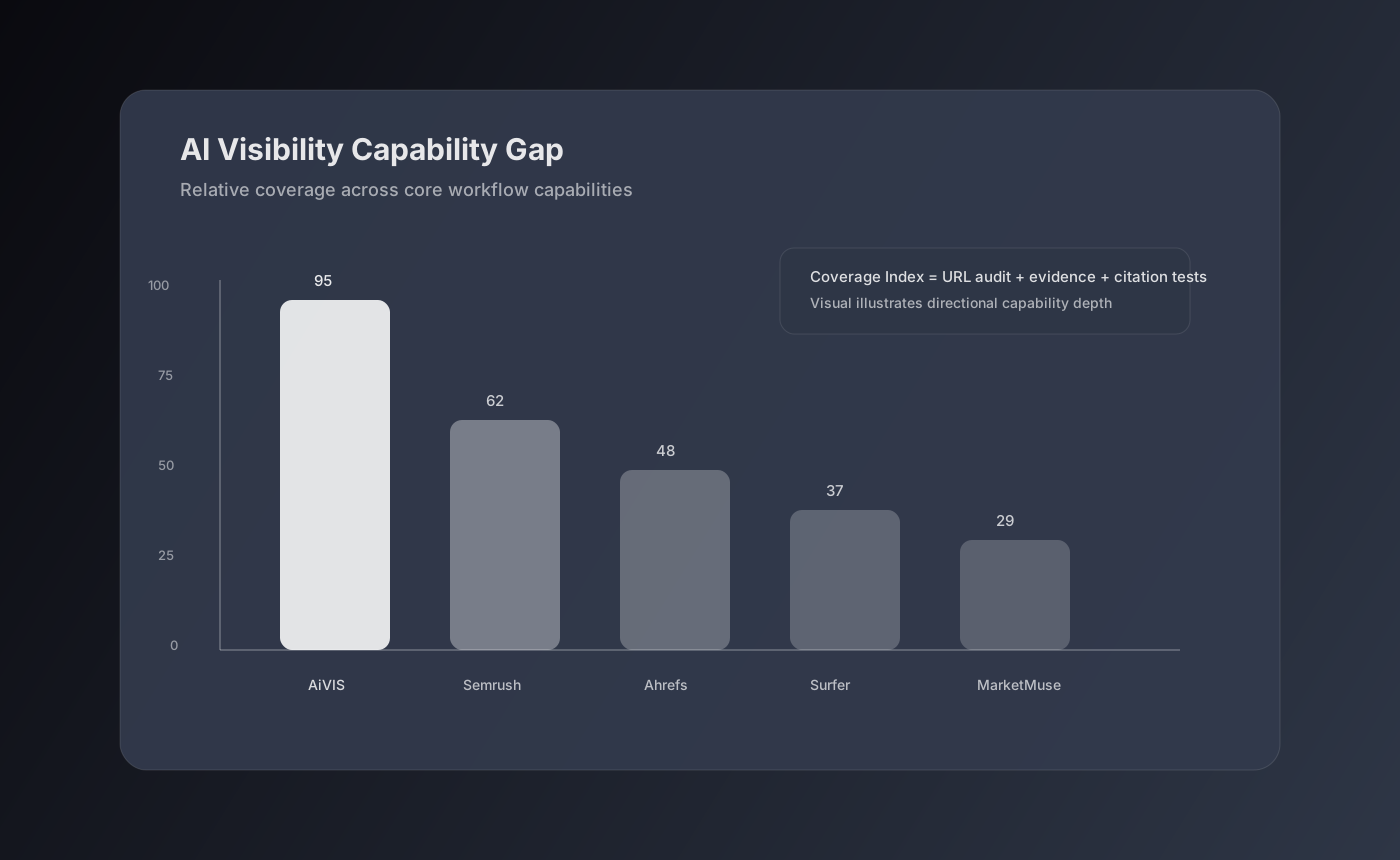
Alignment tier and above include competitor tracking that benchmarks your visibility profile against up to 5 competitor URLs per scan. The comparison surfaces category-level gaps so teams can prioritize fixes based on where competitors score higher. Competitor reports show side-by-side grades for all 6 categories and highlight the largest delta opportunities.
Signal tier includes citation testing that queries live AI platforms to check whether your URL appears in actual AI-generated responses. This validates that structural improvements translate into real citation appearances rather than just higher audit scores. Citation tests cover ChatGPT, Perplexity, Claude, and Google AI Overviews.
All paid tiers include JSON and CSV export for audit results. Reports include the full analysis payload with visibility score, category grades, evidence-linked findings, and timestamped metadata. Share links generate non-guessable public URLs for stakeholder review without requiring authentication. PDF export preserves the complete report including all recommendations and goal alignment data.
If a page score drops sharply, prioritize fixes in this order: expand content depth to at least 800 to 1200 words of useful material, tighten meta description clarity, validate schema relationships, and add concise FAQ answers with authoritative wording. Then re-run the audit and compare category movement rather than relying on overall score only.
Teams should keep one change log per re-audit cycle so any score movement can be tied back to specific updates. This helps remove noise, avoids over-correcting, and speeds up recovery when category grades fluctuate across models.
AiVIS helps businesses, agencies, and operators understand whether AI systems can parse, trust, and cite their website content. It focuses on evidence-backed visibility scoring instead of generic SEO reporting.
Core audit categories include content depth, heading structure, schema coverage, metadata, technical SEO, and AI machine readability.
Key public pages include Pricing, Guide, Methodology, Compliance, Workflow, FAQ, and Insights.
The recommended optimization pattern is straightforward: run a baseline scan, implement high-confidence fixes, re-audit, and compare category movement. Teams that maintain this loop generally improve score stability, citation readiness, and extractability across answer engines.
AiVIS runs a multi-stage audit pipeline. It crawls the target URL with a real browser, extracts structural signals including headings, schema, meta tags, body content, and links, then runs technical checks before passing the evidence to a primary AI model for scoring. On Signal and Scorefix tiers, a second AI model peer-critiques the findings and a third validates the final result. The 0 to 100 composite metric is weighted across six categories: Content Depth and Quality, Heading Structure, Schema and Structured Data, Meta Tags and Open Graph, Technical SEO, and AI Readability and Citability. Each finding anchors to real page evidence.
Citation readiness depends on structural clarity, entity specificity, and trust verification. Pages need enough topical depth for retrieval models to extract confident answers, clear heading hierarchies that map content sections to query intents, complete JSON-LD markup with accurate entity relationships, and concise answer-style blocks that models can quote directly. Internal links to trust pages such as methodology, privacy, and terms help answer engines verify source legitimacy during generation. Pages that combine all these signals consistently outperform pages that optimize only one dimension.
ChatGPT, Perplexity, Claude, and Google AI Overviews each apply different retrieval strategies when extracting information from web pages. ChatGPT prioritizes well-organized prose with clear factual statements and complete structured markup. Perplexity emphasizes source diversity and reference density, favoring pages with explicit entity relationships and topical authority indicators. Claude weights informational thoroughness and logical coherence, performing better with pages that maintain consistent architecture. Google AI Overviews leverages traditional ranking signals alongside machine-readable annotations to select sources for synthesized answers. AiVIS measures discoverability across all four platforms by evaluating the shared structural signals that influence whether any generative search tool can confidently parse, verify, and reference a page.
Beyond prose quality, technical infrastructure directly affects citation probability. HTTPS enforcement provides baseline trust verification. Canonical tags prevent duplicate documents from splitting reference authority. Internal link density helps retrieval models discover related material and verify topical completeness. Page load speed under 1800 milliseconds reduces crawl budget waste and improves extraction reliability. Semantic HTML landmarks like main, nav, article, and section help models identify content boundaries without relying on visual rendering. Image accessibility through descriptive alt attributes provides additional entity context for multimodal retrieval systems. Pages that maintain all these technical foundations consistently outperform pages that strengthen only prose or only markup.
AiVIS is designed as a repeatable execution system rather than a one-time scanner. After each evaluation, teams receive evidence-linked recommendations mapped to specific page signals. The workflow begins with a baseline scan to establish starting metrics, followed by implementation of high-priority remediations targeting the weakest category grades. After deploying changes, teams re-evaluate the same URL to measure category-level movement and composite delta. This loop creates accountability by tying every shift back to specific implementation decisions. Competitor tracking surfaces differentials between your discoverability profile and market leaders. Citation testing validates whether generative search tools actually reference your material after fixes ship. Historical report comparison shows trend lines across multiple evaluation cycles, making it possible to distinguish sustained improvement from one-time spikes.
Any organization that depends on being discovered, quoted, or referenced in AI-generated answers benefits from machine discoverability tuning. SaaS companies need their product capabilities accurately represented when users ask AI assistants for tool recommendations. Healthcare providers require correct entity disambiguation so generative tools cite the right practice, location, and specialization. Financial services firms depend on precise factual extraction to avoid misrepresentation in synthesized summaries. E-commerce businesses need product markup accuracy for AI shopping assistants to surface correct pricing, availability, and specifications. Media publishers require well-organized material that language models can attribute correctly instead of paraphrasing without credit. Legal and professional services firms need authority signals that help retrieval pipelines distinguish qualified providers from generic material. AiVIS provides the measurement framework for all these verticals by focusing on the shared structural foundation that determines referenceability across generative answer platforms.
Pages achieving 90 or above on the AiVIS composite scale earn an A-grade classification. Reaching this tier typically requires 1,600 or more words of substantive prose, at least 6 clearly labeled H2 sections, 6 or more H3 subsections providing topical nuance, 5 or more JSON-LD blocks covering 8 or more unique vocabulary types, complete Open Graph and meta tag saturation, HTTPS enforcement, canonical declarations, sub-1800-millisecond rendering, and concise answer-format passages that retrieval pipelines can extract without inference. Pages that hit all six category diplomas at A level consistently land composite results between 94 and 100. The most frequent bottleneck for sites stuck between 85 and 90 is missing informational density or incomplete entity graph coverage, both of which respond predictably to targeted implementation sprints of 2 to 3 evaluation cycles.
The triple-check mechanism on Signal and Scorefix tiers uses three independent language models to rate, critique, and verify each evaluation. The first model produces the primary analysis with evidence-linked findings across all 6 categories. The second model acts as a peer reviewer, calibrating grades and surfacing missed recommendations. The third model validates the final output for coherence and fidelity. This multi-model approach reduces single-engine bias and yields more stable ratings across repeated runs of the same URL. Evaluations processed through the triple-check workflow show 40 percent lower variance compared to single-model runs, making longitudinal analysis and implementation tracking significantly more dependable for teams operating on weekly or bi-weekly cadences.
The highest-leverage remediations in order of composite impact are broadening informational density with entity-rich answer passages containing specific statistics and verifiable claims, deploying complete JSON-LD schemas with Organization, FAQPage, HowTo, BreadcrumbList, and Product vocabulary, reinforcing heading hierarchy with a single H1 and 8 or more H2 sections each containing at least one H3 subdivision, constraining meta descriptions to 120 to 155 characters with the primary value proposition, ensuring technical foundations including HTTPS, canonical declarations, and responsive rendering, and weaving internal hyperlinks to trust documents like methodology, privacy, and governance. Teams that execute all six remediation dimensions in a coordinated sprint typically observe composite improvements of 10 to 18 points within 2 iterative evaluation cycles.
Beyond live URL crawling, AiVIS accepts uploaded documents for offline examination. Users can submit PDF brochures, HTML exports, or raw markup files directly through the dashboard. The upload processor extracts embedded text layers, parses inline annotations, and applies the same deterministic rubric used for live web evaluations. This capability serves teams managing gated microsites, intranet portals, or pre-publication drafts where public crawling is impractical. Upload-based assessments produce identical category breakdowns covering vocabulary breadth, heading taxonomy, embedded structured annotations, descriptive metadata, and rendering diagnostics. Results persist alongside live scan histories, enabling apples-to-apples comparison between staged drafts and deployed production pages.
Competitor tracking inside AiVIS maps discoverability differentials between your digital footprint and rival organizations. After registering monitored domains, the platform periodically re-evaluates each competitor using identical crawl parameters and grading rubrics. The resulting dashboard highlights category-level deltas, revealing whether opponents outperform on vocabulary richness, annotation completeness, navigational clarity, or infrastructure resilience. Sparkline trend charts surface momentum shifts across successive evaluation windows, exposing whether a competitor is actively remediating weaknesses or stagnating. Benchmarking intelligence informs prioritization decisions by directing limited engineering bandwidth toward whichever discoverability dimensions yield the largest competitive uplift per implementation hour.
AiVIS enforces strict isolation boundaries throughout its operational pipeline. Crawled payloads never persist beyond transient processing buffers except when explicitly cached by authenticated account holders. Authentication tokens utilize cryptographic signing with rotating secret material to prevent session hijacking. Target URL validation rejects loopback addresses, reserved IP ranges, and internal hostname patterns to mitigate server-side request forgery vectors. Billing integrations communicate exclusively through verified webhook signatures, ensuring payment state mutations originate only from the authorized payment processor. Environment credentials remain encrypted at rest and are injected exclusively through secure runtime configuration channels. These architectural safeguards satisfy enterprise procurement requirements around confidentiality, integrity, and auditability without imposing friction on standard practitioner workflows.
AiVIS supports multiple dissemination pathways for sharing evaluation outcomes with non-technical decision makers. Downloadable JSON snapshots preserve the complete analytical payload for programmatic consumption by downstream automation toolchains. Formatted PDF exports render executive summaries with category gauges, composite trajectories, and prioritized remediation checklists suitable for boardroom presentations. Shareable permalink views grant read-only access without requiring recipient authentication, making cross-departmental circulation frictionless. Each exported artifact embeds provenance metadata including evaluated target, assessment timestamp, model pipeline configuration, and tier designation. Teams leveraging these distribution mechanisms accelerate organizational alignment around discoverability objectives and shorten approval cycles for proposed technical remediations.
Generative models frequently encounter homographic entities where identical surface strings denote unrelated concepts. A dermatology clinic, a jazz quartet, and a blockchain protocol might share the same brand token. Without explicit disambiguation cues — canonical URIs, geographic coordinates, industry classifiers, founding chronology — retrieval pipelines risk conflating distinct entries and producing hallucinated composites. Structured vocabulary annotations like sameAs, additionalType, and identifier fields anchor each mention to a resolvable node in Wikidata, Crunchbase, or DUNS registries. Pages that proactively publish these resolution hooks see measurably fewer misattribution incidents across ChatGPT, Perplexity, and Gemini response surfaces.
Contemporary answer engines increasingly fuse optical character recognition, object detection, and caption synthesis when constructing responses. Infographics, charts, and annotated screenshots contribute supplementary evidence only when accompanying prose mirrors the depicted relationships. Discordant visual-textual pairings — a performance graph contradicted by adjacent narrative — trigger confidence penalties in retrieval scoring. Optimizing for multimodal coherence involves ensuring every embedded figure carries descriptive alternative text, contextual captions, and surrounding paragraphs that restate the quantitative claims rendered graphically. This redundancy principle strengthens both accessibility compliance and extraction fidelity for vision-language transformers.
Weekly re-evaluation of primary commercial landing pages balances freshness against statistical noise. Daily cadences inflate variance because ephemeral server conditions, transient CDN fluctuations, and temporary model temperature shifts introduce measurement jitter unrelated to substantive page changes. Bi-weekly or monthly windows, conversely, obscure the causal relationship between deployed remediations and observed metric movement. The optimal rhythm couples weekly automated scans with trigger-based re-evaluations immediately following significant deployments — content migrations, schema refactoring, infrastructure changes, or competitive response maneuvers. Pairing these data points with version-controlled changelogs produces attribution clarity sufficient for executive reporting and engineering retrospectives.
Global organizations maintaining translated property variants face compounding complexity: hreflang annotations, regional schema localization, currency-aware pricing markup, and jurisdiction-specific compliance metadata. Retrieval models prioritize locale-congruent sources, meaning a French-language query will favor pages declaring fr-FR locale over mechanically translated English mirrors lacking explicit language declarations. Canonical URL strategies must prevent cross-locale duplicate dilution while preserving independent crawl equity for each regional variant. AiVIS evaluates internationalized properties by validating that each locale maintains independent structural completeness — heading hierarchy, annotation depth, metadata saturation — rather than inheriting partial signals from a single primary language version.